GO BACK
Mood Check-In: How to Do One Daily (+30 Check-In Questions)
A mood check-in is a quick daily pause where you notice how you feel, what might be behind
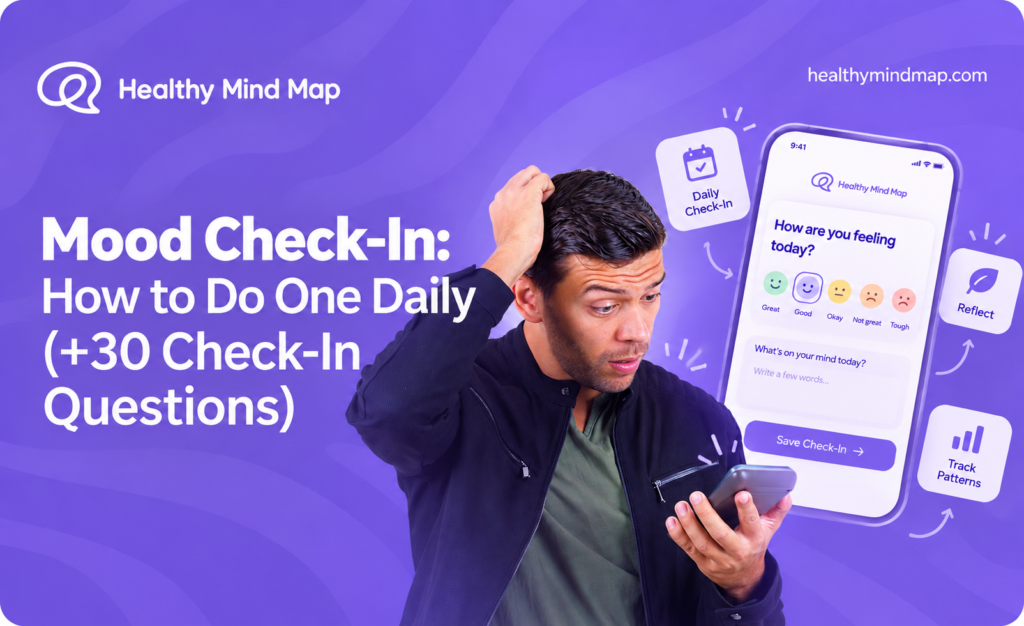


A mood check-in is a quick daily pause where you notice how you feel, what might be behind it, and what you need next. Most days it comes down to three things: a mood score, a word for the main emotion, and a short note about what’s going on.
Most of us don’t notice a rough stretch until we’re already in it. A few short nights, a heavy week at work, a conversation that keeps replaying in your head, and suddenly you’re snapping at people without quite knowing why. A daily check-in gives you a minute to catch that earlier. Keep it up for a few weeks and you’ll also have a record that’s far more reliable than memory.
You don’t need a journaling habit or an elaborate routine to do this. Below, we’ll cover how to do a check-in, how to use a 1-10 mood scale and a mood meter, 30 questions you can pick from, how long it should take, and how to turn your entries into patterns you can actually use. We’ll also show where Healthy Mind Map fits in if you’d rather track on your phone.
It’s a deliberate pause to ask yourself a few simple questions. How am I feeling? What’s the strongest emotion right now? What might have affected my mood today? How’s my body doing? What do I need?
You’re not trying to fix the feeling or talk yourself out of it. You’re just noticing it and writing it down.
Some people log only a score. Others add sleep, stress, energy, or whatever happened that day. Both approaches work. The real value shows up later, once individual entries start to line up.
“I’ve been stressed all week” doesn’t give you much to work with. Three weeks of notes might show that your worst days tend to follow short nights, that stress spikes the day before a particular meeting, or that you feel noticeably steadier on days you get outside. That kind of detail is what makes a check-in more useful than asking yourself whether today was good or bad.
Memory is a poor record-keeper when it comes to mood. One bad afternoon can color how you remember the whole week, and a single great day can make a stressful month look fine in hindsight. An entry made while the day is still fresh gives you something steadier to look back on.
Checking in regularly helps in a few practical ways. You get better at naming what you feel, so “off” turns into “irritable” or “lonely,” which is much easier to do something about. Links between mood, sleep, stress, routine, and time with other people start to show up. Putting a name to an emotion can also buy you a second before you react to it.
Over time, you’ll get a clearer sense of which habits tend to show up on your better days. And if you’re already seeing a therapist, you’ll walk into sessions with more than a vague sense of how the last two weeks went.
What mood tracking won’t do is diagnose anything. It’s a tool for noticing and reflecting, not a substitute for professional care.
There’s no single right method. Pick the one you’ll actually keep doing, because a check-in that feels like a chore won’t last.
A plain notebook works fine. Write a few lines at night, or answer the same couple of prompts each morning: how you feel, what went well, what was hard, what stressed you out, and what helped.
Three honest sentences beat a full page you dread writing.
An app makes it quick to log and easy to scroll back through your history.
Healthy Mind Map pairs check-ins with activity tracking, assessments, and trend charts, so each mood score sits next to what you actually did that day instead of floating on its own. You can read more about how its mood tracking works.
A 4 out of 10 tells you something. A 4 next to “slept five hours, back-to-back meetings” tells you a lot more.
Things worth noting include sleep, stress, exercise, time with people, work or school load, self-care, energy, and anything significant that happened. You don’t need all of them. Pick the two or three that matter most in your life and start there.
New habits stick better when they ride along with old ones. Check in with your morning coffee, over lunch, after brushing your teeth, or right before bed.
The exact time matters less than doing it at roughly the same point each day.
A number keeps things fast. Rate your mood from 1 to 10, then add one line about why.
Mood: 6/10
Why: Slept okay, but work was stressful and I barely had any time to myself.
Mood: 8/10
Why: Better sleep, a morning run, and dinner with a friend.
Two entries don’t say much on their own. Two months of them can.
“Bad” and “fine” cover a lot of ground. Try reaching for something more exact: frustrated, worried, lonely, hopeful, overwhelmed, calm, motivated, disappointed, energized, or content.
The more specific the word, the easier it is to figure out what’s going on and what might help.
Daily entries are the raw material. The useful part comes when you step back and look at them together.
Once a week, skim through and ask yourself: What affected my mood most? Which days felt easier, and what was different about them? What tended to come before the hard days? Has anything shifted since last week?
You’re looking for things worth paying attention to, not proof that one habit causes another.
A 1-10 mood scale is the simplest way to keep check-ins quick and easy to compare. Here’s one way to define each number:
| Score | What it might feel like |
|---|---|
| 1 | An extremely hard day; very low mood |
| 2 | Very low and emotionally heavy |
| 3 | Low; struggling to feel steady |
| 4 | A bit low or drained |
| 5 | Neutral or mixed |
| 6 | Slightly positive, fairly steady |
| 7 | A good day overall |
| 8 | Very good; positive and balanced |
| 9 | Excellent; a strong sense of well-being |
| 10 | Exceptional; one of your best days |
None of these numbers are clinical, and there’s no official definition of what a 6 should feel like. What matters is that your 6 means roughly the same thing from one week to the next. That way, a change in your score reflects a change in you, not a change in how you’re using the scale.
Pairing the number with an emotion and a reason gives you the best of both:
Mood: 7/10
Emotion: Calm
Main influence: Good sleep and a lighter workload
Sometimes a single number flattens things out. You can feel wired and anxious at the same time, or calm but completely worn out. A mood meter handles that by using two dimensions instead of one:
Energy: low to high
Pleasantness: unpleasant to pleasant
Put those together and you get four broad zones:
| Lower Energy | Higher Energy | |
|---|---|---|
| More Pleasant | Calm, peaceful, relaxed | Happy, excited, motivated |
| Less Pleasant | Sad, tired, discouraged | Angry, anxious, overwhelmed |
A quiet evening on the couch might land in low energy and pleasant. The night before a big presentation might sit in high energy and unpleasant. A long day that leaves you flat and fed up is low energy and unpleasant.
Placing yourself on the grid is often quicker than hunting for the perfect word, and it captures something a 1-10 score can miss.
On days when you sit down and draw a blank, a prompt helps. Here are 30 daily mood check-in questions for adults. Don’t try to answer all of them. Pick one to five that fit the day.
These work in a journal, a notes app, a printed worksheet, or a mood tracker. Some people rotate them, using the first five on weekdays and picking a couple of deeper ones on the weekend.
For most people, one to two minutes is plenty. Overcomplicating it is one of the main reasons people give up on mood tracking altogether.
A basic routine might look like this:
30 seconds: Rate your mood from 1 to 10.
20 seconds: Name the main emotion.
30 seconds: Note what influenced it.
20 seconds: Jot down what you need next.
A two-minute check-in you do most days will tell you more than a long reflection you manage once a month. Healthy Mind Map is built around this kind of quick logging, so the habit still fits on your busiest days.
Starting is the easy part. Week three is usually where people drop off. A few things make it easier to stick with.
Keep it short. A score, an emotion, and one note is a complete entry. You don’t owe anyone a paragraph.
Pick a regular time. Checking in around the same time each day means you don’t have to rely on remembering.
Track what’s relevant to you. If sleep and work stress are the big ones in your life, start there. You can add more later.
Don’t grade yourself. A 3 isn’t a failure. It’s information. The aim isn’t a record full of 8s; it’s an honest one, and honest records include hard days.
Watch trends, not single days. One rough Tuesday doesn’t mean much. Five rough Tuesdays in a row might.
Mostly, it turns vague impressions into specific ones.
You might start with: “I’ve been really stressed lately.”
A few weeks of entries might sharpen that into: “My stress runs highest after bad nights and on days when my calendar is packed.”
Or: “I’m in a noticeably better mood on days I exercise and get outside.”
These are leads to follow up on rather than proof that one thing causes another. But they point you toward better questions about your routine, and toward changes that might genuinely be worth trying.
That’s why it helps to log what you did alongside how you felt. Healthy Mind Map’s mental health app brings mood check-ins, activity data, assessments, and analytics together so you can review those patterns over time.
Ever sat down in a session and gone blank on how the past two weeks actually went? It’s common. Between appointments, the details blur: when your mood dipped, what happened right before, what you tried, and whether it helped.
A running record fills in those gaps. It might show that certain situations reliably raise your stress, that you’re bouncing back from hard moments faster than you used to, that a coping technique works in some situations but not others, or that your mood has been drifting slowly over several weeks. Particular habits may also keep showing up alongside your better or worse days.
None of this replaces therapy, assessment, or treatment. It just gives you and your therapist more to work with.
Healthy Mind Map is designed to sit alongside professional care, and it lets you share selected information with a therapist or someone you trust. You can read more about using the therapy tracking app between sessions.
A basic tracker records how you feel. Healthy Mind Map is built to help you understand why, by putting your mood next to everything else going on in your day.
In one place, you get:
You can see everything it includes on the Healthy Mind Map features page.
The two overlap, but they’re not quite the same thing.
A mood check-in is short and structured: a score, an emotion, maybe a few factors like sleep or stress. A mood journal is open-ended, a place to think on paper about whatever’s on your mind.
You don’t have to choose. A daily check-in keeps the habit going with very little effort, and a longer journal entry is there for the days when something needs more room.
Set aside five or ten minutes once a week. Scroll back through your entries and look for changes in mood, energy, stress, sleep, activities, relationships, work or school load, and self-care.
Then ask yourself three questions:
What came before my better days?
What came before the harder ones?
What’s different from last week?
Treat what you find as clues, not cause and effect. If your mood reliably drops after a few nights of poor sleep, for example, that’s worth mentioning to a healthcare professional or using as a reason to take a closer look at your evening routine.
It happens, and it’s worth taking seriously. For some people, scoring and analyzing every feeling adds pressure instead of clarity.
Signs your approach might need adjusting:
If that sounds familiar, change things up. Check in less often, drop the numbers, use fewer questions, or talk it through with a qualified mental health professional. The point is to understand yourself a little better, not to get it perfect.
A minute or two a day is enough. Notice how you feel, think about what might be behind it, and write a line down. Those small entries add up to patterns you’d never catch from memory alone.
Start with the 1-10 scale, one or two questions, and a short note about your day. Once that feels automatic, you can layer in a mood meter, activity tracking, or journaling if you want more detail.
If you’d like it all in one place, Healthy Mind Map brings together daily check-ins, activity tracking, assessments, analytics, and wellness resources.
What is a mood check-in?
It’s a short moment of self-reflection where you notice how you feel, name the main emotion, and think about what may have influenced your mood. It can take as little as a minute.
How often should I do a mood check-in?
Once a day works well for most people, since regular entries make patterns easier to spot. There’s no fixed rule, though. Choose a frequency you can keep up without it feeling like a burden.
Is a 1-10 mood scale useful?
Yes. It’s a simple way to see how your mood changes over time. Using it consistently matters far more than picking a “perfect” number on any given day.
What should I include in a daily mood check-in?
A basic entry can include your mood score, main emotion, stress level, energy, sleep quality, and one event or activity that may have affected how you felt.
What is a mood meter?
A mood meter helps you identify emotions using two dimensions, usually energy and pleasantness. It’s useful for telling apart feelings that might otherwise all get lumped together as “good” or “bad.”
How long should a daily mood check-in take?
One to two minutes is enough for a basic check-in. Keeping it short makes it much easier to stick with.
What are good check-in questions for adults?
A few reliable ones: “How am I feeling right now?”, “What affected my mood today?”, “What gave me energy?”, “What drained me?”, and “What do I need tomorrow?”
Can mood tracking replace therapy?
No. It can build self-awareness and give you useful information to discuss with a professional, but it isn’t therapy, diagnosis, or treatment.
Can mood tracking help when I am already in therapy?
It can. A consistent record helps you remember mood changes, triggers, habits, and coping strategies between sessions, which gives you and your therapist more context to work with.
Is Healthy Mind Map a therapy service?
No. Healthy Mind Map is a self-guided mental wellness and tracking platform. It supports mood tracking, assessments, activities, analytics, and selected information sharing, but it doesn’t replace professional mental health treatment.


Join Healthy Mind Map today. Your first step toward understanding your mental health.